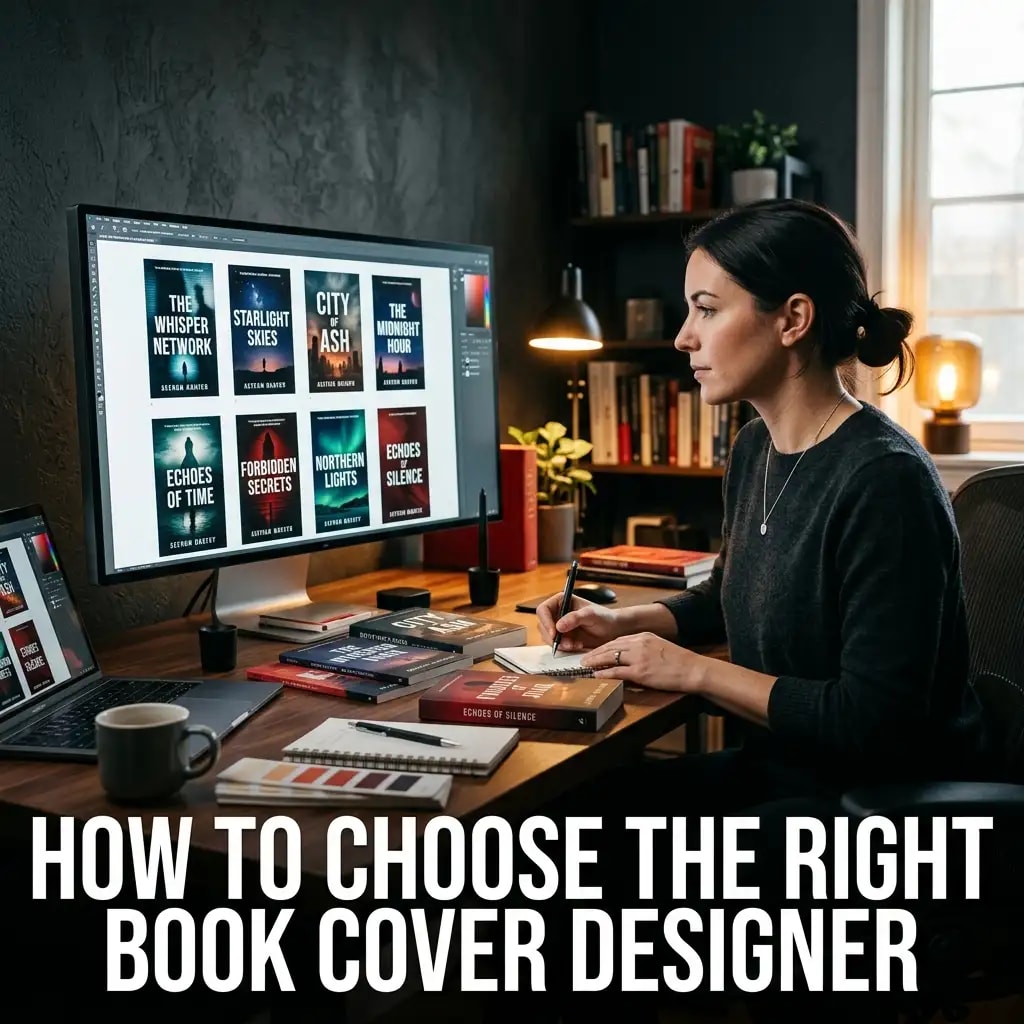
Choosing a book cover designer is one of the most consequential decisions you'll make in your entire self-publishing journey. Get it right, and you have a powerful marketing asset that earns clicks, builds your author brand, and sells books for years. Get it wrong, and you'll spend hundreds of dollars on something you're embarrassed to share, and then spend hundreds more to fix it.
As an author, you're not a graphic designer. You shouldn't have to be. But you do need to know enough to evaluate the person you're hiring, to ask the right questions, spot the red flags, and recognize the markers of true professional quality.
I've been designing book covers professionally for years, and in that time I've heard from hundreds of authors who came to me after a bad experience with a previous designer. The stories are remarkably similar: they hired someone cheap, there was no process, no revisions, the files were wrong, and the cover looked nothing like the genre.
This guide exists so that doesn't happen to you. Whether you ultimately hire me or someone else, these 7 essential questions will help you separate a skilled, professional designer from someone who will waste your time and money.
The Stakes Are High
Your book cover is not a one-time expense. It's a permanent asset that represents your book, and you, to every reader, reviewer, and retailer who ever encounters your work. A bad cover doesn't just look unprofessional. It actively prevents the right readers from finding your book on Amazon, in newsletter promotions, on BookTok, in Bookstagram posts, and in every other discovery channel you'll ever use.
The cost of a bad cover is not the designer's fee. It's every sale you never made because a reader scrolled past.
Before You Start Your Search
Before you post on Reddit asking for designer recommendations or browse Fiverr, you need clarity on three things. Without them, you can't evaluate anyone properly.
📖
Know Your Genre
Not just "fiction", the specific sub-genre. Dark romantasy. Cozy cat mystery. Military science fiction. The narrower you get, the more precisely you can evaluate if a designer has relevant experience.
💰
Know Your Budget
A realistic budget for professional custom cover design is $150–$600+ for eBook, and $250–$900+ for a full print wrap. Anything under $100 is almost certainly not professional quality.
📅
Know Your Timeline
Professional designs take 5–14 business days. If you need a cover in 48 hours, you need to either pay a rush fee or lower your expectations. Good work cannot be rushed into nothing.
"The most important question you can ask yourself before hiring a book cover designer is: Do I know what a great cover in my genre looks like? If not, spend 30 minutes on Amazon first."
Nabin Karna, Cover By Nabin
The 7 Questions You Must Ask
Use these to screen every designer before you commit a single dollar
Question #1
"Can You Show Me Covers You've Done in My Specific Genre?"
This is the single most important question, and the one most authors forget to ask. A designer who produces exceptional Romance covers may be completely out of their depth designing a Military Thriller. Every genre has its own visual language, conventions, colour palettes, and typography norms, and a designer must have deep familiarity with yours to execute it correctly.
A strong portfolio full of gorgeous covers in other genres is not sufficient evidence that a designer can handle yours. Ask specifically for examples in your genre. A good designer will be happy to show them. A designer who shows you a general portfolio and tells you they "can do anything" is giving you a red flag, not a green one.
What to Look For in Genre-Specific Samples
-
The covers feel native to the genre If you placed them on Amazon's search results page, they would blend in with the bestsellers, while still standing out visually.
-
Typography is genre-appropriate The font weight, style, and treatment match what readers expect for that genre's reading experience.
-
Colour palette is intentional and genre-consistent Not random or "pretty", but strategically chosen to signal the genre and mood of the book at a glance.
Red Flag
A designer who says "I can design any genre" but cannot show you actual examples in your genre. Flexibility is good; experience is better. Ask for the samples. If they don't have them, move on.
Question #2
"What Does Your Design Process Look Like From Brief to Delivery?"
A professional designer has a defined, repeatable process. They don't just "start designing" and send you something. They gather structured information from you, do competitive research on your genre, develop initial concepts, present them to you in an organized way, incorporate your feedback, and deliver final files in every format you need.
When you ask a designer to walk you through their process and they can't clearly articulate it, that tells you everything. Design is not a series of random creative acts, it is a disciplined professional service. The process protects both you and the designer.
What a Professional Design Process Looks Like
Discovery & Creative Brief
A structured questionnaire or consultation to understand your story, genre, audience, comparable titles, and visual preferences.
Genre & Market Research
Studying current bestsellers in your genre to understand design conventions and identify opportunities for differentiation.
Concept Development & Initial Draft
Creating the initial design concept, including image selection/compositing, typography treatment, and colour grading.
Revision Rounds
Incorporating your feedback in defined revision rounds. Typically 2–3 rounds are included in a professional contract.
Final File Delivery
Exporting and delivering all final files in the correct formats and specifications for your chosen platforms (KDP, IngramSpark, etc.).
Red Flag
A designer who asks for your title and author name and starts designing immediately, with no questionnaire, no research, no brief. Speed is not a virtue in design. A designer who skips the discovery phase will design something generic, because they don't know enough about your specific book to design something meaningful.
Question #3
"What Software Do You Use, and Are Your Images Properly Licensed?"
This question reveals more about a designer's professional standards than almost anything else. The software a designer uses determines what is possible in terms of quality, detail, and flexibility. The licensing of the images they use determines whether your book cover is legally safe to sell commercially.
Software: What Professionals Use vs. What to Be Wary Of
✓ Professional Tools
- ✓Adobe Photoshop: industry standard for photo manipulation, compositing, and colour grading
- ✓Adobe Illustrator: for vector graphics, logo work, and print-safe typography
- ✓Adobe InDesign: for complex print layouts and full wrap-around cover construction
- ✓Affinity Publisher/Photo: a professional-grade alternative to the Adobe suite
⚠ Concerning Tools
- ✗Canva (free tier): templates are shared by millions; limited resolution control; restricted for commercial print
- ✗PicsArt / Fotor: consumer photo editing apps, not professional design tools
- ✗Microsoft Word / PowerPoint: never appropriate for book cover design under any circumstances
Image Licensing: This Is Non-Negotiable
Every image used on your commercially-sold book cover must be properly licensed for commercial use. This means the designer must either use images from reputable stock libraries (Adobe Stock, Shutterstock, Depositphotos), commission original photography, or use images that are explicitly cleared for commercial publication.
If a designer uses a free image from Google, a watermarked photo, or an AI-generated image without the proper rights clearance, you could face a copyright infringement claim. This has happened to self-published authors, and it can result in your book being removed from sale.
Always Ask
"Where do your stock images come from? Are they licensed for commercial use on a commercially-sold publication?" A professional designer will answer this without hesitation and provide the licensing information in your contract or delivery documents.
Question #4
"What File Formats Will I Receive, and Are They Platform-Specific?"
This question catches a shocking number of amateur designers completely off guard. Many "designers" will deliver a JPEG at screen resolution and consider the job done. For a book you're publishing on Amazon KDP and IngramSpark, that is not even close to sufficient.
Different publishing platforms have specific, and very different, technical requirements for cover files. Getting them wrong means your book either won't upload, won't print correctly, or will look blurry on high-resolution devices.
Platform File Requirements at a Glance
| Platform | Format | Min Resolution | Special Notes |
|---|---|---|---|
| KDP eBook | JPEG or TIFF | 2,560 × 1,600 px | 72 DPI acceptable; sRGB colour space |
| KDP Print | 300 DPI | Full wrap with spine + bleed; CMYK or RGB | |
| IngramSpark | PDF/X-1a | 300 DPI | Strict PDF/X-1a standard; CMYK only; fonts embedded |
| Barnes & Noble Press | JPEG or PDF | 300 DPI | Similar to KDP; check current specs on site |
| Draft2Digital | JPEG | Minimum 1,400 px wide | eBook-only distribution; sRGB recommended |
A professional designer should deliver: the high-resolution layered source file (PSD or similar), a print-ready PDF for each platform you need, a web-optimised JPEG for Amazon KDP eBook, and a social media version (square format) for your marketing. If a designer only delivers a single JPEG, that is not a professional deliverable.
Red Flag
A designer who is unfamiliar with the difference between KDP and IngramSpark file specifications, or who doesn't know what PDF/X-1a means. If they can't speak confidently about the platforms your book will be published on, they are not the right designer for a self-publishing author.
Question #5
"How Many Revision Rounds Are Included, and What's Your Change Policy?"
Revisions are a fundamental part of the design process. No designer, no matter how talented, will nail your exact vision on the first draft without any feedback. Good design is collaborative. You should expect to review initial concepts, provide structured feedback, and see a revised version before final approval.
The key is clarity: how many revision rounds are explicitly included in the quoted price, and what counts as a revision versus a scope change? Misunderstandings about this are the most common source of conflict between authors and designers.
What's Reasonable to Expect
2–3 structured revision rounds included
This gives you meaningful input at key stages, after the initial concept, after the first revision, and a final polish, without creating an open-ended revision loop.
Clear definition of what constitutes a revision
A revision is a refinement of the existing concept (change text colour, adjust composition, swap one image). A complete concept change, redesigning from scratch, may be a scope change.
Additional revisions available at a transparent rate
If you want more revisions beyond what's included, a clear additional fee (e.g., $25–$50 per round) is reasonable and professional.
"Structured revision rounds protect both author and designer. They give you real creative control, while keeping the project moving forward toward a final, approved result."
Red Flag
Either extreme is a warning sign. A designer who offers "unlimited revisions" is either very cheap (and very fast, meaning low quality) or setting you up for a frustrating, never-ending process with no clear endpoint. A designer who offers zero revisions is not interested in collaboration and will likely produce something generic.
Question #6
"Who Owns the Copyright of the Final Design, and Do I Get the Source Files?"
This is a legal question that most first-time authors forget to ask, and it can create serious problems later. Copyright ownership in design work is not automatically transferred when you pay for the work. In many jurisdictions, the designer retains copyright by default unless there is an explicit written agreement transferring it to you.
Why does this matter? Because without copyright ownership, you may not be able to:
- Modify the cover design in future (e.g., adding "Bestseller" or updating a series badge)
- Use the cover artwork for merchandise, posters, or box sets
- Licence the cover image to publishers if you transition to traditional publishing
- Have the cover modified by a different designer without the source files
Source Files: What to Ask For
Source files (typically a layered Photoshop .PSD file) give you the fully editable version of your cover. With source files, you can update text, adjust sizing, or have another designer make changes in the future. Without them, you're dependent on the original designer for any change, forever.
Note: Some designers charge an additional fee for source file delivery (typically $50–$150), and this is common and reasonable. What's not acceptable is refusing to provide them under any circumstances, or demanding ongoing licensing fees for their use.
What to Confirm in Writing
Your contract or invoice should explicitly state: (1) full copyright transfers to you upon final payment, (2) the images used are properly licensed for commercial use, and (3) source files are either included or available for an explicit additional fee.
Question #7
"Can I Read Testimonials or Reviews from Authors You've Worked With?"
Design quality is objective in some ways, you can look at a portfolio and make an informed judgment. But the experience of working with a designer, their communication, responsiveness, reliability, ability to understand feedback, and professionalism throughout the process, can only be evaluated by people who have actually worked with them.
Testimonials and reviews are not just marketing materials. They are evidence of working relationships. Read them carefully. Look for:
🔍 What to Look for
- ✓ Authors mentioning the design process felt collaborative
- ✓ References to the designer truly "understanding" the genre or story
- ✓ Mentions of responsive communication and timely delivery
- ✓ Authors reporting improved sales, CTR, or visibility after the cover
- ✓ Repeat clients, authors who returned for their next book
⚠ Warning Signs in Reviews
- ✕ Reviews only mention the visual result, not the process
- ✕ All reviews are short and generic ("Great work!", "Fast delivery!")
- ✕ No reviews from authors in your specific genre
- ✕ No reviews at all, or reviews only on the designer's own website with no third-party verification
- ✕ Multiple reviews mentioning communication problems or missed deadlines
Also ask if you can directly contact a past client. A designer confident in their work and their client relationships will welcome this. One who deflects or makes excuses is telling you something important.
Pro Tip
Check the designer's Google Business reviews, their Facebook page, and author community forums like Kboards or 20BooksTo50K. These third-party sources are far harder to fake than testimonials on the designer's own website.
Where to Find Professional Book Cover Designers
Armed with your 7 questions, you need to know where to actually look. Here's an honest breakdown of the main channels and what you can realistically expect from each:
Specialist Book Cover Design Agencies & Studios
Designers who work exclusively in book covers (like Cover By Nabin) have the deepest genre knowledge and the most relevant portfolios. They understand the publishing ecosystem, platforms, file specs, market trends, in a way generalist designers typically do not. This is where to start your search.
Best for: Quality, genre expertise, professional process
Reedsy Marketplace
Reedsy vets its freelancers, meaning designers on the platform have been reviewed and approved for quality. Prices tend to be on the higher end, but the vetting process reduces the risk of hiring an amateur. All communication and payment happens through the platform, which adds accountability.
Best for: Vetted professionals; mid-to-high budget
Author Community Recommendations
Facebook groups for self-published authors (20BooksTo50K, Indie Author Group, genre-specific communities) are excellent sources of real author recommendations. When a real author vouches for a real designer by name, with their actual cover as evidence, that is highly credible information.
Best for: Community-verified recommendations; all budgets
Fiverr / Upwork (Proceed with Caution)
There are genuinely skilled designers on Fiverr and Upwork. There are also a great many who are not. The problem is that the platform's review system can be gamed, and the low price points attract authors who then accept low quality because they paid low prices. Apply the 7 questions rigorously. Look for designers with 100+ reviews, specific book cover portfolios, and clear pricing for revisions and file formats.
Caution: Highly variable quality; requires careful vetting
The Honest Pricing Reality Check
Let's talk numbers, because the single biggest source of bad cover designs is authors who allocate too little budget and then wonder why the result is disappointing.
What Your Budget Gets You in 2026
Under $50
Canva template with your text dropped in. No custom compositing. No genre research. No professional typography. Likely not print-ready. Will look like what it is.
$50–$149
Variable quality. Some skilled designers offer entry-level packages here. Many do not. Ask all 7 questions carefully before committing. Revisions often very limited.
$150–$400
The professional sweet spot for custom eBook covers. Custom photo-manipulation, professional typography, revision rounds, platform-ready files, and a structured process. This is the baseline for taking your book seriously.
$400–$900
Full wrap-around print covers, series packages, and premium custom designs. Includes full KDP/IngramSpark print-ready PDF, spine design, back cover layout, and often source file delivery. The right investment for a serious indie publishing business.
If you already have generated artwork, AI cover rescue applies the same print-ready standard to it.
Remember: you are not paying for a designer's time. You are investing in an asset that will represent your book to every potential reader it ever reaches, potentially for decades. Evaluated on that time horizon, a professional cover is one of the highest-ROI investments in your publishing career.
Frequently Asked Questions
How do I find a good book cover designer?
How much should I pay for a book cover designer?
What should I look for in a book cover designer's portfolio?
Do I own the copyright of my book cover design?
How long does it take to get a book cover designed?
Should I use the same designer for my whole series?
The Right Designer Changes Everything
Finding the right book cover designer is not about finding the cheapest option or the fastest turnaround. It's about finding someone who truly understands your genre, brings a professional and transparent process, delivers work that is technically complete for every platform you need, and earns the trust and confidence that comes from a strong track record with real authors.
The 7 questions in this article are your filter. Any designer worth hiring will answer all of them clearly, confidently, and without hesitation. Any designer who stumbles on more than one of them deserves to be crossed off your shortlist, regardless of how pretty their portfolio looks on first glance.
Your manuscript is a work of craft and passion. It deserves a cover designed with the same level of intentionality, expertise, and care. When you find the right designer, the collaboration should feel like a partnership, not a transaction.
Your next great cover is one good question away.
You've Found Your Designer
Let's Answer All 7 Questions
Together.
I'd love to walk you through exactly how I'd approach your cover, the process, the research, the files, and the collaboration. No pressure, just a clear picture of what working together looks like.
Custom covers · Genre expertise · KDP & IngramSpark ready · Full copyright transfer